







Overview
Bridging the Gap Between Silence and Connection
Speech and language therapy supports the development of both verbal and non-verbal communication. At Terteeb, we provide parents with clear guidance on speech milestones, empowering you to make the best decisions for your child’s growth. Our goal is to replace uncertainty with a structured path forward.
Knowing when to seek help can be confusing. We start every relationship by listening understanding the person in front of us before recommending anything.
Auditory-Verbal Therapy (AVT)
Helping children with hearing loss develop listening and spoken language skills, empowering them to communicate through audition.
Articulation and Phonology
Social Communication Skills
Gestalt Language Processing (GLP) Support
Voice Therapy
Swallowing (Feeding and Dysphagia Support)
Augmentative and Alternative Communication (AAC)
Speech Language Therapy
Find your voice.
We will help you use it.
Communication is more than speaking it is being understood. Every child communicates, whether through words, gestures, or even the frustration of a tantrum. If your child is struggling to express themselves or missing key developmental milestones, Terteeb is here to help.
Early intervention is the key to lasting progress. The sooner we start, the better we can support your child’s ability to find their voice and build confidence.

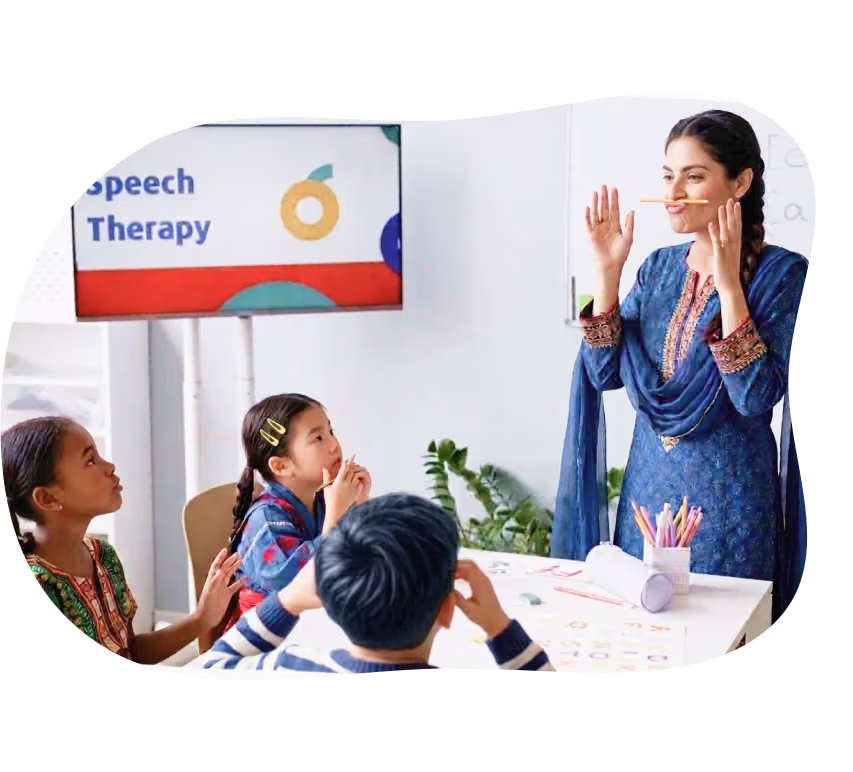

How Terteeb's Speech Therapy Services Help

Our interventions support a wide range of communication needs.
At Terteeb, our speech-language pathology interventions are designed to support children and adults facing a wide range of communication and developmental challenges.


Speech sound disorders & delays
Feeding & swallowing
Alternative & Augmentative Communication (AAC)
Cleft lip & palate
Emotional regulation
Receptive & expressive language
Swallowing
Social communication
Childhood apraxia of speech
Receptive & expressive language
Reading & writing
Stuttering & cluttering
Testimonials
Hear from other parents and caregivers.


For just over a year, I have entrusted my son’s journey to Terteeb a decision that has undoubtedly been the most beneficial one I have ever made. His therapist is truly remarkable.
Grazielly Borges
a month ago
My child has benefited greatly from the therapy program offered by Terteeb. The center’s caring and organized approach have equipped my 6-year-old with the necessary tools for success.
Deuzt C.
a month ago
The Terteeb team has been an extraordinary asset to our family. They deliver exceptional therapy and have facilitated remarkable progress in our son’s communication and social abilities.
Bonnie B.
a month ago



FAQs About Speech Therapy
Frequently asked questions.
How Does Speech Therapy Help Children With Autism?
It helps improve speech clarity, language understanding, and social communication empowering children to better express themselves at home, in school, and in daily life. Our approach is neuro-affirming, meaning we build on strengths rather than focusing on deficits.
When Should My Child Start Speech Therapy?
Early intervention is key if you have any concern, reach out now. We support children from age 2, and we also welcome adults. There is no “too early” or “too late” when it comes to communication support.
What Happens In A Speech Therapy Session For Kids?
Sessions are play-based, child-led, and tailored to each individual. Our therapists use activities the child genuinely enjoys to build communication naturally, without pressure or compliance-based goals.
What Are The Best Techniques For Speech Delay?
Techniques vary by child often including modelling, play-based language therapy, AAC, and parent coaching so that progress continues at home between sessions. Our team creates a personalized plan for each child.
Can Toddlers Do Speech Therapy?
Absolutely. We welcome children from 2 years old. The earlier we support language development, the better the long-term outcomes for communication, confidence, and social connection.
Contact Terteeb today to provide your child with the care and support they deserve.


Need advice or a consultation on speech therapy, learning disabilities, neurodivergence, or hearing impairment? Not sure where to start? That is exactly why we are here.